Reading a Commercial Electric Bill Before You Size a Solar Project
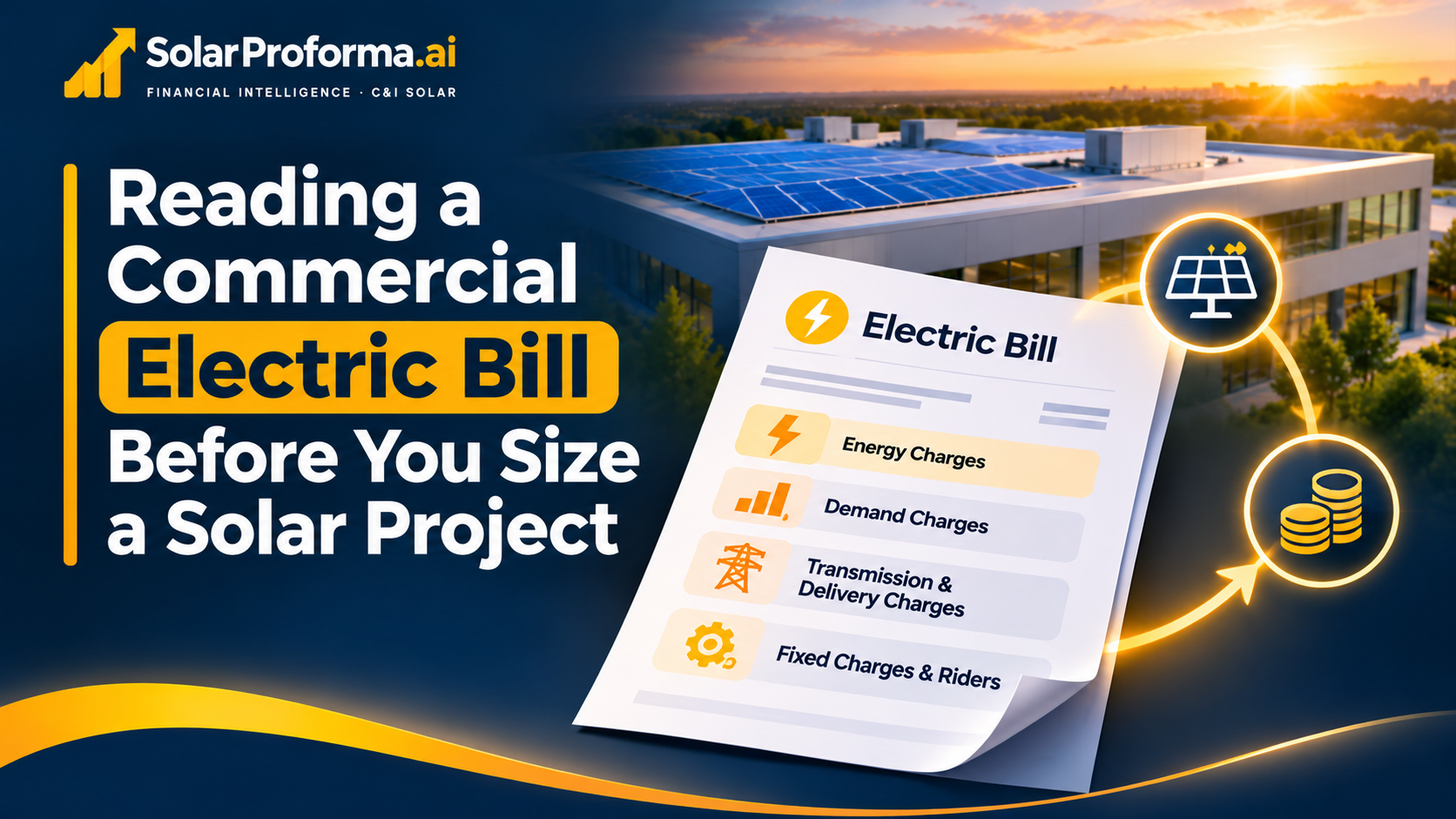
Two buildings can have the same roof, the same solar system and the same annual energy use, and still see very different savings. The difference usually isn’t in the panels. It’s in the electric bill. A commercial bill is made of several charges, and solar doesn’t reduce all of them the same way. If a proposal assumes every kilowatt-hour of solar saves the building’s average rate, the savings estimates can be off before the project is even built. Here’s how to read a commercial bill before you size the system, and why it matters for the proposal you put in front of a building owner.
Why the Average Rate Can Mislead You
A quick way to estimate savings is to divide the total bill by the total kilowatt-hours and multiply bysolar production. It’s simple, and it’s often wrong. That average rate blends charges that solar affects strongly with charges it barely touches. When the mix is different from what you assumed, the real savings come in lower or higher than promised. For a building owner deciding whether to invest, that gap matters.
1. Energy Charges
Energy charges are billed per kilowatt-hour consumed. This is the part of the bill solar reduces most directly: every kilowatt-hour the system produces and the building uses is a kilowatt-hour it don’t buy.
Things to check:
- Is the energy rate flat, tiered or time-of-use?
- If it’s time-of-use, when are the peak and off-peak periods?
- Does solar production line up with the higher-priced hours?
Under a time-of-use rate, the same kilowatt-hour can be worth more at one hour than another. Solar that produces during expensive hours is worth more than the average rate suggests. Solar that produces mostly during cheaper hours is worth less.
2. Demand Charges
Demand charges are based on the building’s highest power draw during the billing period, usually measured over a short interval such as 15 minutes. They are billed per kilowatt, not per kilowatt-hour.
This is where many savings estimates go wrong. Solar can lower demand, but only if the system is producing at the moment the peak happens. A cloudy interval, an early morning start-up or an the evening peak can set the demand charge even in a sunny month.
Questions to ask:
- When does the building’s peak demand usually occur?
- Is there a demand ratchet, where a past peak sets a minimum charge for future months?
- Are there separate on-peak and maximum demand charges?
If demand charges are a large share of the bill, savings should be modeled from interval data where possible, not assumed from production totals.
3. Transmission and Delivery Charges
Delivery and transmission charges cover the cost of moving power to the building. Depending on the utility and tariff, they can be billed per kilowatt-hour, per kilowatt, or as part of a fixed charge.
This detail changes the savings math. A delivery charge billed per kilowatt-hour usually falls when solar reduces consumption. A charge billed per kilowatt of demand behaves more like a demand charge. A fixed charge doesn’t change at all.
4. Fixed Charges and Riders
Most commercial bills include a monthly customer charge and a list of riders, surcharges and taxes. Some are fixed and stay the same no matter how much solar the building has. Others are calculated as a percentage of the bill or per kilowatt-hour. They’re easy to skip, but including the fixed portion in an average rate overstates what solar can save.
5. What Happens to Excess Production
If the system sometimes produces more than the building uses, the rules for that exported energy matter. Depending on the utility and state, exported energy may be credited at the full retail rate, at a lower export rate, or not at all.
Before sizing the system, confirm:
- Whether the site is eligible for net metering or another export program
- What rate exported energy is credited at
- Whether credits roll over from month to month
A system sized to offset 100% of annual use can look attractive on paper but deliver less value if a large share of production is exported at a low rate.
How to Put It Together
Reading the bill well comes down to a few steps:
- Collect at least 12 months of bills, and interval data if it’s available
- Separate energy, demand, delivery and fixed charges
- Note the rate structure, including time-of-use periods and any demand ratchet
- Model savings charge by charge instead of using one average rate
- Size the system around what the building can actually use and value
This takes more work than a single blended rate, but it produces a savings estimate a building owner can trust, and one that holds up when they compare it with their bills after installation.
How SolarProforma.ai Helps
SolarProforma.ai helps bring utility-bill assumptions into the project economics so energy, demand and other bill components can be evaluated separately rather than relying on one blended electricity rate.
Frequently Asked Questions
1. Why can’t I use the average electricity rate to estimate solar savings?
The average rate mixes charges that solar reduces, like energy charges, with charges it may not reduce, like fixed fees or some demand charges. Using it can overstate or understate real savings.
2. Do solar panels reduce demand charges?
They can, but only if the system is producing when the building’s peak demand occurs. Because demand is set by the highest short interval in the month, a single cloudy or evening peak can limit the savings.
3. What is a demand ratchet?
A demand ratchet is a tariff rule where a high peak in one month sets a minimum demand charge for following months. It can reduce the demand savings solar delivers.
4. How many months of bills do I need to size a commercial solar system?
At least 12 months is a good starting point, so seasonal changes in use and rates are captured. Interval data makes the analysis more accurate, especially for demand charges.
5. Does exported solar energy save as much as energy used on site?
Not always. Depending on the utility and state, exported energy may be credited at the retail rate, a lower export rate, or not at all, so it’s important to check the program rules before sizing.
The Bottom Line
For behind-the-meter C&I solar, the electric bill is one of the most important starting points. Energy, demand, delivery and fixed charges each respond to solar differently, and treating them as one average rate is the fastest way to get the savings wrong.
Read the bill charge by charge, size the system around what the building can actually use, and the proposal you present will hold up long after installation.
Start your 14-day free trial of SolarProforma.ai and evaluate your next project’s savings charge by charge.