From Design to Dollars: Turning C&I Solar Designs into Financeable Deals

A solar project can perform well technically and still fail to make financial sense.
For commercial and industrial (C&I) solar developers, EPCs, investors, and asset owners, the technical design is an essential first step. Platforms such as PVsyst, HelioScope, Aurora, and Energy Toolbase help teams understand system design, production, and expected performance.
But once the design is complete, the conversation changes.
The questions become:
• Does the project actually work financially?
• What are the expected IRR and NPV?
• How does a PPA compare with a Prepaid PPA?
• How do ITC and MACRS affect project economics?
• What assumptions are driving the returns?
• Can the financial case be presented clearly to a CFO, investor, or lender?
Your solar design proves it performs. SolarProforma.ai shows whether the deal works.
Technical Performance Is Only Half the Equation
Solar design software answers important technical questions. It helps teams model production, evaluate system performance, and build the technical foundation of a project.
But production data alone does not tell you whether a project is commercially viable. A C&I solar project also needs to be evaluated based on costs, financing structures, tax considerations, cash flow, returns, and other financial assumptions.
Historically, many solar teams have handled this transition manually. Technical information is exported from design software and then transferred to spreadsheets to build the financial case.
That process can mean rebuilding calculations for every opportunity, maintaining multiple spreadsheet versions, and spending significant time checking whether technical and financial assumptions remain aligned.
The challenge is not getting the solar design right. The challenge is turning that design into a financial case that can help move the deal forward.
From Project Data to Deal Economics
A commercial solar financial model brings together the information needed to understand the economics of a project.
Instead of looking only at expected energy production, developers can evaluate the financial factors that determine whether an opportunity deserves further attention.
These can include:
• Project costs
• Energy production
• Cash flow
• IRR and NPV
• PPA and Prepaid PPA structures
• ITC
• MACRS depreciation
• Domestic Content considerations
• FEOC requirements
• Financing assumptions
• Long-term project economics
The value of bringing these elements together is simple: it gives the project team a clearer view of what the numbers actually mean for the deal.
For a developer reviewing multiple opportunities, that can help answer an important question earlier in the process:
Is this project worth pursuing further?
Stop Rebuilding Financial Models in Spreadsheets
Spreadsheets are still part of many commercial solar workflows. They can be useful for analysis, but manually rebuilding a financial case every time project assumptions change can slow down the process.
A change in project cost may require updated calculations. A different PPA structure may require a new scenario. A change in tax assumptions can affect the returns. Different project inputs can mean another round of spreadsheet work.
For teams evaluating multiple C&I solar opportunities, this creates unnecessary friction between technical design and financial decision-making.
SolarProforma.ai is designed to help reduce that gap by bringing project data and financial analysis into a workflow built specifically for commercial solar.
The objective is not simply to create another spreadsheet. It is to help teams evaluate opportunities faster, compare financial structures, and move deals forward.
Compare the Financial Structure of the Deal
A solar project can be structured in different ways, and those structures can produce different financial outcomes.
For example, Cash Ownership, PPA, and Prepaid PPA can each create different cash-flow profiles and economic considerations.
Comparing these structures within the same financial analysis gives developers and other stakeholders a better understanding of how the project changes under different scenarios.
Questions can include:
• How does Cash Ownership compare with a PPA?
• How does a Prepaid PPA change the project economics?
• What happens to IRR under different assumptions?
• How does NPV change between scenarios?
• How do tax benefits affect the overall financial case?
Expanded commercial loan and customer-ownership financing is also being developed for SolarProforma.ai. The goal is to provide a more complete financing comparison as that capability is finalized.
For now, the focus remains on the financing structures and financial capabilities available today, while the expanded Loan functionality is being developed.
IRR, NPV, and Understanding Whether the Deal Works
Two of the most important measures in a solar project financial model are Internal Rate of Return (IRR) and Net Present Value (NPV).
IRR helps stakeholders understand the expected return generated by a project’s cash flows. NPV helps evaluate the value of those future cash flows based on the project’s investment and required return assumptions.
But these numbers are only useful when the assumptions behind them are clear. A change in project cost, financing structure, tax treatment, or commercial terms can change the financial outcome.
That is why solar IRR and NPV should be evaluated as part of the complete project economics rather than viewed as isolated numbers.
For developers and investors, the goal is to understand not only the return, but also what is driving that return.
Tax Considerations Are Part of the Financial Model
Tax incentives can have a significant impact on commercial solar project economics. The Investment Tax Credit (ITC) and MACRS depreciation are important considerations when building a commercial solar financial model.
Domestic Content and FEOC considerations can also affect project economics and sourcing decisions.
These factors should therefore be considered alongside project costs, financing structures, cash flow, and expected returns.
A financial model that brings these assumptions together can provide a more complete picture of how different project decisions affect the deal.
From Financial Analysis to a Deal-Ready Proforma
Financial modeling is ultimately about making a project easier to evaluate and communicate. Developers need to determine whether an opportunity is worth pursuing, EPCs need to explain the economics to customers, investors and asset owners need visibility into returns and assumptions, and financial stakeholders need a clear case they can review.
SolarProforma.ai is designed to help C&I solar teams move from project information to a clear financial picture and create proformas that can support these conversations.
MODEL. ANALYZE. DELIVER.
The SolarProforma.ai approach can be viewed through three stages.
MODEL
Build the financial case around the structures available today:
Cash • PPA • Prepaid PPA
Expanded commercial loan and customer-ownership financing is being developed as the Loan capability is enhanced.
ANALYZE
Evaluate the financial factors that influence the opportunity:
IRR • NPV • ITC • MACRS • Deal Economics
This helps teams understand how different assumptions and structures affect the overall project economics. DELIVER
Turn the analysis into a clear proforma that can support discussions with:
CFOs • Investors • Lenders
The goal is to make the financial case easier to understand, review, and use as a project moves forward.
Built for C&I Solar Teams
Commercial solar projects require more than technical production estimates. Developers need to screen opportunities efficiently, EPCs need to communicate project economics clearly, and investors and financial stakeholders need a structured view of returns and assumptions.
SolarProforma.ai brings these needs into a financial modeling workflow built specifically for C&I solar—helping teams move from “How will this system perform?” to the question that comes next: “Does this deal work financially?”
The Bottom Line
Your solar design proves it performs. SolarProforma.ai shows whether the deal works.
By connecting project data with commercial solar financial modeling, SolarProforma.ai helps developers and EPCs evaluate opportunities, compare available financing structures, understand project economics, and prepare clearer financial cases for the people involved.
The goal is straightforward:
Stop rebuilding financial models in spreadsheets. Start moving deals forward.
Frequently Asked Questions
What is commercial solar financial modeling software?
Commercial solar financial modeling software is a platform that takes production data from solar design tools and converts it into a complete financial analysis, including IRR, NPV, tax credit stacking, depreciation, and financing structure comparisons, so developers and investors can evaluate whether a project is bankable, not just whether it performs well technically.
How is a Prepaid PPA different from a standard PPA?
A standard PPA involves no upfront cost, with the offtaker paying only for energy as it is produced. A Prepaid PPA involves a significant upfront payment in exchange for a lower effective energy rate over the life of the agreement, along with different mechanics around who claims the tax benefits and when ownership eventually transfers.
How do the ITC, Domestic Content, and Energy Community adders stack together?
The base Investment Tax Credit is 30 percent. Meeting the Domestic Content threshold adds 10 percentage points, and siting a project in a qualifying Energy Community adds another 10, allowing a well structured commercial project to reach a 50 percent federal credit before MACRS depreciation is even factored in.
How does MACRS depreciation interact with the Investment Tax Credit?
Claiming the ITC reduces a project’s depreciable basis by half the credit amount, which changes the calculation for every year of the five year MACRS schedule that follows. Modeling the credit and the depreciation schedule separately is one of the most common ways manual spreadsheets miscalculate a project’s true after-tax return.
What is FEOC compliance and how is it different from Domestic Content?
FEOC, or prohibited foreign entity, compliance is a separate test introduced in 2026 that evaluates a project’s material assistance cost ratio based on supply chain sourcing. A module can meet the Domestic Content bonus threshold and still fail FEOC requirements, since the two frameworks reference overlapping supplier data but apply different qualifying criteria.
Can I import project data from PVsyst, HelioScope, or Aurora directly into SolarProforma.ai?
Yes. SolarProforma.ai is built to import production data directly from these design platforms, removing the manual export and spreadsheet rebuild step and letting developers move straight from a completed technical design into a full financial model.
Related articles
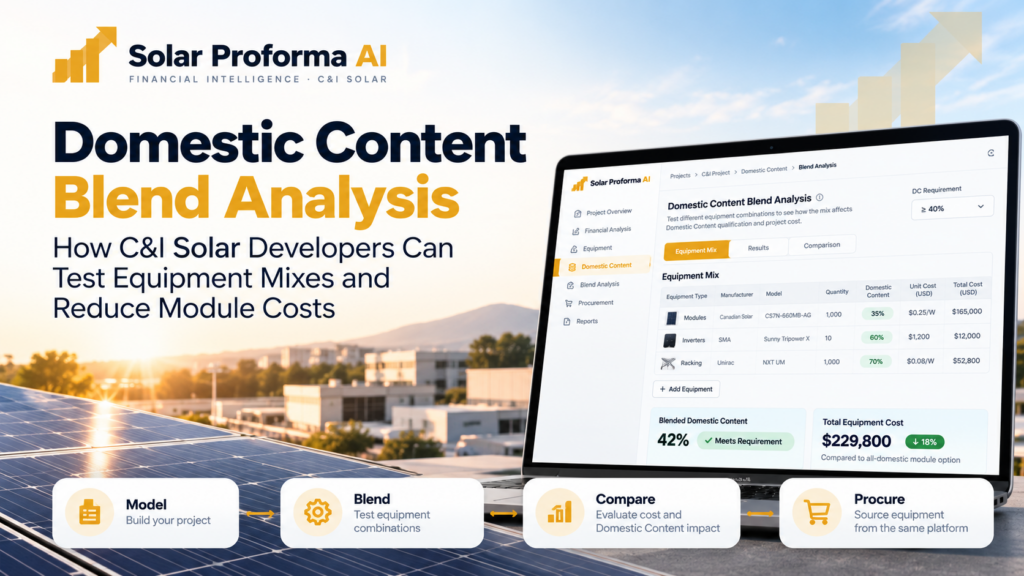
Domestic Content Blend Analysis: Can C&I Solar Developers Lower Equipment Costs Without Sacrificing the Incentive?
For C&I solar developers, Domestic Content creates an interesting question: Do you really need to buy the most expensive domestic modules to qualify? Not…
Read article